Wednesday, 29 January 2014

The Country Diary of an Edwardian Lady by Edith Holden (January)


Fleur Fisher, in her post about The Country Diary of an Edwardian Lady at the end of December got me thinking.

I've loved this unique and inspiring book since I found my copy of it in a second-hand shop years ago.  When the girls were little we used to frequently head out with our sketchbooks to try to capture little items in nature - twigs, snowflakes, squirrel nests, flowers.  The impetus for these outings came from Edith Holden and our love of her delicate, intimate nature journal.  We would settle down on a blanket in a field or in the back garden or beside a mountain trail and try to capture on paper a little piece of the natural world.


If I were of an artistic bent I would get out the watercolours.  Alas... these days I have accepted my lack of abilities in that vane and the watercolours remain (thankfully) tucked away - but I do love photography.  I have decided to read along month-by-month in the Country Diary and find inspiration for seeking out the beauty in nature in my own corner of the world.  All the photos I will post will be my own, inspired in some way by this beautiful book.

Coyote beside the road on the edge of town.
Hoar frost at my front door.
We call these "Magic Rowan Berries"

Prairie dog on high alert
Hoar frost in the neighbour's garden.

Sunday, 26 January 2014

Dinner at the Homesick Restaurant by Anne Tyler


In my early 20s one of my absolutely favourite books was Anne Tyler's The Accidental Tourist.  The lure of Macon Leary's reclusive, idiosyncratic lifestyle contrasted with Muriel Pritchett's charming extroversion helped me figure out my own place in the world and where I wanted to fit, and who I wanted to be.  I identified so strongly with the characters in that book in all their diversity, yet had never read anything else by Anne Tyler until this month when I picked up Dinner at the Homesick Restaurant.  I didn't know what to expect, but I don't think I was expecting it to be quite as bleak as it was.

The Tull family is a cautionary tale of bad parenting and communication failure.  Abandoned by her husband, Pearl Tull raises her three children on her own.  Each of the children is scarred in secret and unknown ways by this void as well as by their mother's emotionally closed off personality.

Anne Tyler

I found this story frustrating because of the lack of emotional resolution, and the blindness that each of the characters deals with and never overcomes.  Each is searching for a way to satisfy some deep need: one son is overwhelmed by his ambition for control, money and power, the daughter is incapable of being serious about anything or of maintaining a marriage, and the youngest son searches for a loving home life, first at the home of his friend, later in his creation of a home-style restaurant.

This book left me cold.  I didn't connect with any of the characters, even with the telling of the story from many different perspectives (which was stylistically very well done) I failed to really invest in the challenges or dramas.  I just found myself getting more and more frustrated that none of these characters would stand up for themselves - or take a stand about anything! The youngest son, Ezra, is so determined to have the whole family around the table together eating, yet his efforts are constantly belittled and undermined by every member of the family.  Still he never stands up for himself.  It made me wonder why they didn't all just cut their losses.

 I know that Anne Tyler is a well-loved author who has won the Pulitzer Prize and that her novels are included in countless syllabi in American secondary and post-secondary schools so clearly I am in the minority in my disappointment.  This was very easy reading and I did find the changing points of view refreshing but although the style allowed me to make it through to the end of the novel the content felt unresolved and contrived.  I often think of a quote I heard years ago: "If you can't be a shining example at least be a cautionary tale."  Clearly I enjoy books about shining examples much more than cautionary tales.

Saturday, 25 January 2014

To Everything a Season: A Year in Alberta Ranch Country by Marilyn Halvorson


Marilyn Halvorson lives on a cattle ranch near Sundre, Alberta.  She is a teacher, and the author of several well-known YA novels set in ranch country such as Cowboys Don't Cry, and Nobody Said It Would Be Easy.  This is a year long journal beginning in September 1989 in which the author documents her life on the land, her work as a cattle farmer, and (the focus of every farmer's life) the changing weather.

I really enjoyed the passages in which she shares her observations on the natural world.  There were moments of profound insight that had me appreciating her perspective:

Though nature can be cruel, she will not take without giving in return.  Hope walks hand in hand with despair.  I met it on the creek bank as well.  There stood a grove of young balsam poplars, shedding their coloured leaves and preparing for the death season ahead.  But as I looked more closely at the trees, I made a discovery.  Beside each dying, falling leaf was a leaf bud, sticky and tightly curled but as complete and perfect a leaf as it will be next May.  Surely this is hope - and faith.  A tree not yet stripped of this year's leaves, with eight months of fall and winter ahead of it, yet ready and waiting for that first warm week in May.

and:

While I am out poking around in the field I hear a sound far above.  I look up.  A long, ragged line of geese is plowing purposefully southeast across the heavy sky.  I count, surprised at how hard it is to keep up with the moving line.  There are ninety-five of them.  They disappear into the distance, still calling back ever-fainter farewells to the north.

But along with the inspiration and occasional wonderful descriptions of the nature world, there also seemed to be a cynical undertone that I found quite depressing.

The butterflies are out today in the hot Indian summer sun, orange and brown velvet ones.  Happy.  Unaware that, surely, in a few days they will be dead.  What does that matter?  That will be then.  Today the sun is shining.  The world is wonderful.

Marilyn Halvorson comes across as a slightly cranky farmer, and a bit curmudgeonly living a life divided between the farm and her teaching (she rarely mentions that she is a writer).  Often the daily entries seemed like a few rushed words jotted down at the end of a busy day when summary of the weather and few incidents from the day come to mind.  There was not a lot of narrative flow, and not often did I find it was insightful or inspiring or even very elucidating.  Overall, I was disappointed by this journal, although there were some moments when she captured the reality of life on the land with clarity and precision.

Marilyn Halvorson

Wednesday, 22 January 2014

Little Free Library #1: Hetty Dorval by Ethel Wilson

The Little Free Library Project

I decided at the beginning of 2014 that I would read exclusively from my own shelves for the first six months of the year: I have enough books to keep me busy for twice that amount of time without hardship, and until I clear some space on my shelves I really have nowhere to put any more books anyway.  However, I also decided to bend the rules for a once-a-month dip into one of the Little Free Libraries that have sprung up in my neighbourhood.  I was thrilled to find a copy of Hetty Dorval in a library decorated as a purple dinosaur, so I left a book from my own collection and happily headed home with my find.


Just like my favourite read of 2013 (Surfacing by Margaret Atwood) I immediately turned from the last page back to the first and re-read every word.  It is entirely possible that my second book of the year may well end up being my favourite - it was just that good!

Although Hetty Dorval earns the title of the novella, this is really the story of Frances "Frankie" Burnaby, and her coming-of-age teen years first in a village in British Columbia, and later in England and France.  In her first person narration Frankie reveals more to the reader than she realizes about herself, and her developing personality; we see how she grows into her place in society.  It is a tale not of Hetty Dorval, but of Frankie's reaction to the idea of Hetty Dorval.

There is ambiguity in Hetty's portrayal; we never really get to know her.  She desires isolation from the complications of deep personal interaction, and as a result is both unknown and unknowable to those around her.  Is this perniciously anti-social behaviour deserving of absolute rejection?  And how exactly is one to go about ostracising a recluse?  Is it even possible to cut oneself off from the rest of the world?  The recurring references to John Donne's "No man is an iland, intire of it selfe; every man is a peece of the Continent..." inform one interpretation of Hetty's character.  There are groups of outsiders who populate the periphery of the story who demonstrate the socially acceptable ways of being separate:

The Indians, in small groups, moved always together, as by some inner self-protective compulsion, like certain birds, with their own particular kind of awareness.

Both the Indians of Lytton and the visiting circus folk keep together as a group even in their social isolation.  But what do we do with a single woman who breaks all the rules of acceptable behaviour without appearing to be in any way affected?  These are the questions this story raised for me, and continue to make me ponder.  The answers are not in the story but in our personal reaction to it, just as the novella is a document of Frankie's reaction to an alternate way of being in the world.

Hetty Dorval, the novella, is about the essential inscrutability of human nature.  Can we ever really know each other?  Can we ever really know ourselves?  Are we even aware of the prejudices and social customs that act upon us in ways that allow us to adopt specific and unbending beliefs and rules of behaviour?  Does Frankie realize that she is unquestioningly perpetuating the same narrow social parameters of her parents, and even allowing them to colour her younger, more honest perception of the world?

Like all great writers (and Ethel Wilson is most certainly one) there is enough ambiguity in the story for us to make up our own minds about the characters.  Do we believe Frankie's narration without question?  Is there room for other interpretations of the story she has told?  It is a reminder that we all go through life seeing the world through our own eyes, and this perspective can be too narrow to be the whole truth.  Opening our eyes to the possibility that there are other completely valid perspectives is the work of a great story.

Although this book is widely available in Canada, I suspect it would have been more difficult to find in other countries until Persephone Press reprinted it.  I believe Ethel Wilson is the only Canadian author represented in their catalogue.  I would highly recommend this book, and would love to discuss it!

Ethel Wilson

Thursday, 16 January 2014

Shadows on the Rock by Willa Cather

I found another unfinished review from last month.  I am feeling well enough to read now that I no longer have to take pain killers that muddle my brain, but have not been able to sit at the computer for longer than a few minutes so things have been relatively quiet here.  I have given myself the grace of the month of January in which to rebuild my strength and health, and am very grateful that I am able to get out for walks around the neighbourhood between blizzards and record snowfall, icy sidewalks permitting.

I read Willa Cather's Shadows on the Rock at the end of November and enjoyed it so much that it made my list of favourites for the year.  I had a lot more to say about this fantastic book, but since I know that I will be returning to it again, I have decided to go ahead and post these rather abrupt thoughts.


I have come to the writing of Willa Cather quite late.  Her writing was never assigned to me in school, even in the American Literature class I took in university, and until I found a copy of My Ántonia in a charity shop I knew very little about her writing.  I enjoyed My Ántonia - the first book of 2013 for me.  When I was looking through the appendices of Janet Friskney's New Canadian Library I was surprised to see Shadows on the Rock in the list of titles considered but never included in the series.  Why would a writer so American as Willa Cather be considered for this series of books that are historically significant to Canada?  I took myself to the library and found a beautiful Vintage Classic copy (the cover above) and devoured the work during one chilly Saturday.

This is a work of historical fiction set during one year (which begins in October, 1697) in colonial New France.  It is the story of twelve year-old Cecile Auclair, who, along with her apothecary father Euclide Auclair is just as transparent and open as their name suggests. This is a quiet novel in which the focus is on the small events, the everyday occurrences of relatively unimportant people living in exile from the rest of the world in the isolated colony.  The story is episodic rather than plot-driven, and begins with the return of the last ships to France in preparation for the long winter of seclusion that is to come.

For me, the most interesting aspect of the novel is the theme of the immigrant never quite belonging to the culture from which they come, or to the one in which they live.  Although I have always lived in Canada, and never been an international "immigrant," I have lived in twenty-two houses in five provinces in my lifetime, and strongly identify with the immigrant's quest for "home."  My daughters have lived in the same home in Alberta their whole lives, while my husband and I consider Kingston, Ontario - 4000 km away - to be our emotional centre. This leads to frequent discussions about home in our house!  When I was a girl, I felt much like Cecile for whom Quebec is home even though for her father, France is home and Quebec is a temporary place to stay.

She put the sled-rope under her arms, gave her weight to it, and began to climb. A feeling came over her that there would never be anything better in the world for her than this; to be pulling Jacques on her sled, with the tender, burning sky before her, and on each side, in the dusk, the kindly lights from neighbours’ houses. If the Count should go back with the ships next summer, and her father with him, how could she bear it, she wondered. On a foreign shore, in a foreign city (yes, for her a foreign shore), would not her heart break for just this? For this rock and this winter, this feeling of being in one’s own place, for the soft content of pulling Jacques up Holy Family Hill into paler and paler levels of blue air, like a diver coming up from the deep sea.

This is the story of how the French colonists became Canadian.  Cecile becomes like Maria Chapdelaine, the Mother of the Canadians.  Generally speaking, psychological development of the characters is minimal, although the depth of Cecile's fears of upheaval in the impending return to France are vividly realised.  I think this book would deeply resonate with immigrants of all kinds (international, or interprovincial!).  It is about making "a place to stay" into a home, and the use of story to do that.  Stories that are told become the history of the community, and the way of knowing about one's past, one's surroundings and one's place.  We are grounded and rooted through the emotional links we create to the land, to our neighbours, to our institutions.  Willa Cather has given us a sense of the creation of home in Quebec through the stories she includes.

Now that I have read it, it is less surprising to me that this novel was considered for the New Canadian Library series than that it was rejected (this decision may have been a matter of copyright logistics rather than content) for Cather did not just set her novel in what became French Canada, but just as significantly, adopted many of the prevailing themes of the literature of Canada.  We see Northrop Frye's "garrison mentality" at play (Quebec is a refuge in the wilderness), and we see the theme of "home" and stasis explored (as opposed to the expansionist and movement-prone themes in American literature).  I am looking forward to reading Death Comes for the Archbishop to see if she is able to achieve the same thematic sympathy with the New Mexico Territory that she does with seventeenth-century New France.

Although this novel must have taken an astounding amount of research, Willa Cather never turns it into a history lesson.  The intimacy of the setting and the characters gives this novel a human scale which is its true charm.

Here are some images of some of the real characters found in Shadows on the Rock:

Frontenac: "The Fighting Governor"

Bishop Laval

Jeanne-Le Ber by Bottoni, 1908
Jeanne-Le Ber website

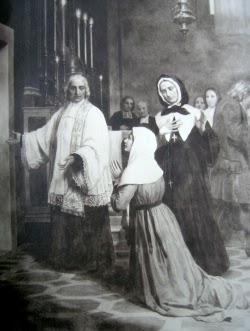
Mother Juschereau de Saint-Ignace
Mother Juschereau de Saint-Ignace website

You can read the entire text of Shadows on the Rock at the Gutenberg site online.
I highly recommend it!

Willa Cather

Thursday, 9 January 2014

Wild by Cheryl Strayed

I had a vague recollection of having written something about Cheryl Strayed's Wild at the beginning of December, but a lot of things from the first week of December are fairly foggy for me.  When I opened the draft I was surprised to see that it was as complete as it is.  So, I am posting it as it is:
 

The travelogue is a particularly favourite genre of mine.  A travelogue written by a woman hiking an extended wilderness trail alone is sure to catch my interest.  I was surprised when I saw the 2012 publication date on Cheryl Strayed's Wild: From Lost to Found on the Pacific Crest Trail because it seems as though I've been hearing about it for years.  I heard her interviewed when the book was first released and I thought, "That sounds right up my alley!"  But then I stumbled on a few online reviews, the jist of many expressing the opinion that the author was whiney and self-pitying, perhaps a bit self-indulgent, and with boundary issues about how much private information is Too Much Information.  And then Oprah gave it her stamp of approval.  Well, I read it anyway, and have to say that I really, thoroughly enjoyed this book.

Wild is a memoir of the summer of 1995 when the author treked long portions of the Pacific Crest Trail in California and Oregon.  Cheryl Strayed hiked 1100 miles on her own in an attempt to come to terms with the loss and pain in her life.  With connections to The Pilgrim's Progress continually coming to the surface, Strayed records her journey carrying her enormous rucksack she named "Monster."  As she progresses, the weight of her burden is lighter as she becomes stronger.  This book is heavily weighted with this kind of symbolism.

The entire journey is examined with almost twenty year hindsight, but never feels nostalgiac or sentimental.  Strayed is a bluntly honest writer, telling all even when it is unflattering and embarassing.  There were definitely some squirm-inducing moments, but I respected her need to tell the whole story.  She explores her family history, the death of her mother, the abusive birth father, the traumatic death of a horse.   I will admit to reading some of these scenes through squinted eyes, skimming first to prepare me for what was to come. But it never got so bad I had to skip or stop reading.  She writes with the same frankness about sexual encounters, menstruation and heroin use, and with an unvarnished honesty that I admired even whilst feeling a tad uncomfortable with the bluntness of it.

I suspect it has probably taken Cheryl Strayed all these years to appreciate how important that summer was in her life.  Many of the revelations must have happened long after the trek was complete, for as she says, the expectation that she had before her trip (that she would be filled with catharitic experience sitting by a mountain lake at sunset) was pushed aside by the reality of just surviving the ordeal of traversing the land every day with too-small boots and a too-heavy rucksack.

When I was twenty-two I left Canada for a six-month trek around Europe alone.  While my journey was considerably less physically arduous, and I definitely had more opportunities for bathing, I could identify with many of her experiences as a woman traveling alone.  It brought back many wonderful memories of the deep bonds that can form between travellers, and the transformational quality of long-term travel.

Cheryl Strayed

Some of my favourite travel memoirs:
  • A Walk in the Woods: Rediscovering America on the Appalachian Trail by Bill Bryson
  • The Voyage of the Northern Magic: A Family Odyssey by Diane Stuermer
  • Into Thin Air: A Personal Account of the Mt. Everest Disaster by Jon Krakauer
  • Vagabonding: An Uncommon Guide to the Art of Long-Term World Travel by Rolf Potts
  • Slow Journeys: The Pleasures of Travelling by Foot by Gillian Souter
  • Zen and the Art of Motorcycle Maintenance: An Inquiry into Values by Robert Pirsig
  • Seven Years in Tibet by Heinrich Harrer
  • Long Way Round: Chasing Shadows Across the World by Charley Boorman and Ewan McGregor
  • Giant Steps: The Remarkable Story of the Goliath Expedition From Punta Arenas to Russia by Karl Bushby
  • The Woman Who Walked to Russia: A Writer's Search for a Lost Legend by Cassandra Pybus
  • Scraping Heaven : A Family's Journey Along the Continental Divide by Cindy Ross
  • How the Heather Looks: A Joyous Journey to the British Sources of Children's Books by Joan Bodger

Tuesday, 7 January 2014

The View from Castle Rock by Alice Munro


My first book of 2014 was intended to start me out on the path I intend to follow this year.  I have decided that I need to read more short fiction - especially more collections of short fiction - and what better place to start than with Alice Munro?  Early in 2012 I read the title story of this collection (and recorded a few thoughts here).  But the story read in context of the whole collection becomes richer, more nuanced, even more powerful.

The View from Castle Rock is a book that defies categorisation; it sits on its own with elements of memoir, short fiction, and the novel weaving in and out.  After years researching her family history, Alice Munro found herself fascinated by the people in her past.  The stories in the first half of the book are her imagined histories of these ancestors who emigrated from Scotland in the early nineteenth-century to the area now known as Alice Munro Country.  In the second half of the book she writes about the family she knows, about her parents, her relatives and herself.

I found a lot in this book that resonated with me, especially in the latter stories.  As the descendent of those same Presbyterian Scots who emigrated to the area just a county or two south, a generation or two later than her ancestors I saw reflections of my own family history in more than one story.  But the unique ability of Alice Munro to create characters with such humanity, such depth, such truth, without resorting to cliche or sentimentality is astounding.  They are characters who stick with me.  I find myself thinking of them long after closing the book, remembering the way Aunt Charlie sat at the sewing machine, or the way Russell walked when he carried his trombone, the light on the apple blossoms and the feeling of swimming beside the boathouse on Georgian Bay.  She writes about herself in such a disarming manner - she seems to have such clarity about how it felt to have been herself so many years ago, for I recognise the truth of her discomfort, her inability to know what to say at the right moment, her hesitations, her secret desires.

I am looking forward to reading more Alice Munro this year, along with a few other collections by Diane Schoemperlen and Margaret Laurence and Lisa Moore and Mavis Gallant.

Alice Munro photo credit: Paul Hawthorne/Canadian Press

Tuesday, 31 December 2013

The Blue Castle by L. M. Montgomery


During my recent ill health I turned to L. M. Montgomery's The Blue Castle as a comfort read of sorts.  My mother was here to help during and after my hospital stay and when she saw me reading it she told me that it was my grandmother's favourite Montgomery.  I loved hearing that, and it is perhaps a little glimpse into my sentimental side when I say that I think it made me enjoy the book even more.  It has been years since I last read it so most of the finer points of plot and character have long been forgotten.  I remembered it as a simple romance, improbable and sentimental, but amusing.  Since that last reading I have read all five volumes of L. M. Montgomery's published journals as well as Mary Henley Rubio's Lucy Maud Montgomery: A Gift of Wings which clearly added to my reading of The Blue Castle this time around.  Remembering the scorn and frustration she expressed in her journals toward some of the members of her husband's congregations, and with her husband himself, it was clear to see that she was working out some of her angst in this story!

The Blue Castle is the story of Valancy Stirling and her transformation from a brown-frocked spinster to modern lover.  At first glance what appears to be a simple and uncomplicated romance offers fertile ground for contemplation.

The first sentence states, "If it had not rained on a certain May morning Valancy Stirling's whole life would have been entirely different."  This preoccupation with fate is explored throughout the novel.  To what degree is the path of our lives determined by mere chance, how much is preordained and what role does free will play?  A humourous but socially marginalised character challenges church doctrine on predestination and his argument prevails over those of the theologians.  Just so, the protagonist Valancy questions the validity of her status as a member of the "elect," as a daughter of the well-respected Stirling family.  She throws off the shackles of her birthright, a status confirmed on her not by merit or effort but by chance, and consciously choses her own path to self-fulfillment.  Free will here is for the courageous visionaries.  It is a new world order we see envisioned in The Blue Castle, and it is the brave, those undaunted by fear who are able to transform themselves through their own efforts and live in freedom and happiness.

Valancy's favourite author, the naturalist philospher John Foster gives us the overarching theme of the novel: "'Fear is the original sin,' wrote John Foster.  'Almost all the evil in the world has its origin in the fact that some one is afraid of something.'"  Most of the characters are ruled by fear; "What will people think?" dictates every behaviour of the dour Stirling clan: it is the wagging finger of the church leader, and the gossip of the townsfolk.  Fear has dictated the rules of belief and behaviour that make life a prison for those who abide.

L. M. Montgomery allows us to see what happens when a character is given the opportunity to cast off the fear that keeps her confined.  A natural lifestyle is equated to a modern one, and all that is traditional and established is equated with outdated, passionless, stagnant, disease-causing artificiality.  In the fantasy world free from society's artificial constraints, clothes are valued for their comfort, food is simple and nourishing, sleep comes in a rhythm that matches the needs of the body, there is a connection to the land that is entirely lacking in society, and the needs of the emotional life are fully met.  The psychological interior and exterior appearance begins to meld and the emotions break through the shell of social contraint.  When this happens, social regulations strictly delineating class structure become meaningless.  The true measure of a human is no longer the superficial attributes of wealth, social position, family name or appearance.  It's a wonderful fantasy!  And L. M. Montgomery places before us a projection of what could be possible if one were brave enough to take the reigns of one's own life, to cast off all that is unnatural, staid and conventional, to live a utopian existence where all emotional needs are met.

Of course, I am always fascinated by fictional character who struggle with illness, and Valancy Stirling is an interesting case.  Diagnosed at the beginning of the story with a fatal heart ailment, Valancy is given a year to live.  The illness narrative itself is merely a plot device, and not of nearly as much interest as the real psychological ramifications of the diagnosis.  The mind can create its own cure when it is deprived of its natural nourishment, and Valancy has created a place of peace, comfort, and escape in her imaginary blue castle.  L. M. Montgomery addresses both the cause, but also the remedy for this psychologically distressing lifestyle where, trapped in a world where creativity is stifled, solitude forbidden, novels strictly disallowed, the mind finds its own healing.  One senses that Valancy's retreat to this internal world of fantasy and of books is something L. M. Montgomery wrote straight from her heart.  This internal world served to fulfill all her basic emotional needs and soothed her soul until Valancy was able to manifest her heart's desire in reality.  When her reality was offering her all the emotional support she needed, her fantasy world was no longer needed - her inner and outer lives had merged.

Lucy Maud Montgomery

I know that The Blue Castle is one of L. M. Montgomery's quietly popular books after the Anne and Emily series.   I loved the descriptions of the Muskoka region of Ontario, of the contrast between the musty Stirlings and the moonlight canoe trips.  The darkness that often lurks just below the surface in L. M. Montgomery's writing is here; she does not shy away from social ills and uncomfortable topics such as illegitimate children, alcoholism, depression, illness, bullying, death, neglect, hypocrisy.  There is a constant undercurrent of negativity, but it is counter-balanced by her overwhelming optimism.  The old will die away, and the new world will bloom, reborn.  The new ruling religion is based not on the rules of the past but on love and joy in nature.  The "shock of joy" is the birth pang of a new life, but the resurrection is not dogmatic, but firmly grounded in the pleasure of earthly joys.

Monday, 30 December 2013

Thursday, 19 December 2013

My Favourite 13 of '13

It has been an excellent year of reading!  Going over the list of books that I read this year made me so thankful that I have access to the voices of so many talented writers, and that I am able to engage freely in conversation about the books I read.  Choosing my favourites for the year was not so easy this time around.  For my Favourite 13 of '13 I decided to limit my choices to books that I read for the first time this year.  That automatically eliminated some of my most enjoyable reading experiences so I've added my favourite re-reads at the bottom.

I have been facing some challenges to my health this fall, culminating in a 9-day hospital stay this month.  I have Ulcerative Colitis, and suffered a serious flare-up at the beginning of the month.  I had hoped to catch up on writing about some of the wonderful books I read, especially in November, but I have to accept that is not going to happen.  I have linked back to my original thoughts on each of my favourite books and will be happy to talk about the unlinked selections if you are curious about any of the titles.  I am very disappointed not to be able to share my thoughts on some of the most amazing books I read this year (Merilyn Simonds' The Holding, Irmgard Keun's The Artificial Silk Girl, Willa Cather's Shadows on the Rock...) but have decided to let it go.

1. The Old Capital by Yasunari Kawabata.

2. The Sacrifice by Adele Wiseman.
3. Earth and Ashes by Atiq Rahimi.
4. La Guerre, Yes Sir! by Roch Carrier
5. Tay John by Howard O'Hagan.
6. Where Angels Fear to Tread by E. M. Forster.
7. One Happy Moment by Louise Riley.
8. The Artificial Silk Girl by Imgard Keun.
9. W;t, A Play by Margaret Edson.
10. Ada Blackjack: A True Story of Survival in the Arctic by Jennifer Niven.

11. Surfacing by Margaret Atwood.
12. Shadows on the Rock by Willa Cather.


13.  Wild: From Lost to Found on the Pacific Crest Trail by Cheryl Strayed


Most Enjoyable Re-reads

The Old Man and the Sea by Ernest Hemingway.
The Handmaid's Tale by Margaret Atwood.
The Accidental Tourist by Anne Tyler.
The Enchanted April by Elizabeth von Arnim.
The English Patient by Michael Ondaatje.
The Holding by Merilyn Simonds.

I look forward to seeing everyone's end-of-year summaries, and the goals and challenges for next year.

Wednesday, 18 December 2013

Sunday, 15 December 2013

The Little Free Library Project

 photo credit: Ali Eminov

Have you heard of the Little Free Library?

From the website:

It’s a “take a book, return a book” gathering place where neighbors share their favorite literature and stories. In its most basic form, a Little Free Library is a box full of books where anyone may stop by and pick up a book (or two) and bring back another book to share.

Little Free Libraries have been turning up all over my neighbourhood and of course I've been having a peek, and occassionally finding a new book to enjoy.  I have decided to add this as a regular series on my blog as my way of sharing the love.

Please feel free to join me in the celebration of the Little Free Library movement!

[And special thanks to Ali Eminov for including this photograph of a Little Free Library in the creative commons of flickr.]

A list of the books I have enjoyed from Little Free Libraries:

  1. Hetty Dorval by Ethel Wilson (1947)

Thursday, 5 December 2013

Word to Caesar by Geoffrey Trease


In the remote Roman garrisons in northern Britain, young Paul witnesses devastating barbarian attack which destroys the fort he has called home, and leaves him an orphan.  He escapes with his life thanks to Severus, a Roman poet who offers Paul his protection.  Paul discovers that his debt to Severus can be repaid, but it requires that he travel to Rome, a homeland he has never visited, and deamands bravery, quick wit and a lot of luck.

In typical Geoffrey Trease style, this adventure is action-packed, and involves all manner of jumping into rivers from prison windows, escaping face-to-face encounters with angry lions, outrunning bloodhounds through the forest in bare feet (!), and using a diamond ring to cut a hole in a glass window pane not once, but twice! 

Although Trease wrote his stories for both girls and boys (usually including a protagonist of each gender to share the stage) Word to Caesar is disappointingly light on female characters.  There are three in total: one is a nasty spy, one an annoying brat, and the third shows up near the end and disappears just when things get really dangerous.  This aspect of the story was much less satisfying for my daughter to whom I was reading it aloud.

The historical aspects of the Roman setting were much less convincing than when he writes about Britain in the same period.  However, he does take great care in describing the details of the Circus Maximus, and that made up for any lack in the fact that Rome was otherwise fairly nondescript.  We both agreed that Geoffrey Trease writes a good adventure story, although this was perhaps not his finest effort.  However, it is exactly the kind of historical fiction Elizabeth and I both enjoy.

Geoffrey Trease

Tuesday, 3 December 2013

Strange Things by Margaret Atwood


Strange Things was first presented as a series of four lectures at Oxford University in 1991 as part of the Clarendon Lecture Series in English Literature.  With her characteristic sense of humour, Margaret Atwood explores the The Malevolent North in Canadian Literature through three different themes: the mysterious, magnetic lure of the sinister North, the north as a place of renewal and the urge of non-Native peoples to connect with the aboriginal people and the land,  and the North as the home of the Wendigo, the snow monster. In her fourth lecture, these themes are re-examined through the women writers who have adapted them for their own purposes.


Concerning Franklin and his Gallant Crew

The first lecture tells the story of Sir John Franklin and his crew of 135 who left England on a polar expedition in 1845 in search of a pre-Panama Canal commercial trade route through the Arctic.  The mysterious disappearance of their ships the Terror, and the Erebus has long inspired artists and writers.  Margaret Atwood looks at work by E. J. Pratt, Gwendolyn MacEwen, Mordecai Richler and Robert W. Service, and how the lure of the north calls out to the "ancient hubris in the dreams of men".

...and my favourite: Stan Roger's Northwest Passage (link to Youtube video)


The Grey Owl Syndrome

After the death of naturalist, writer, lecturer Grey Owl, it was discovered that he was not in fact an Ojibwa, but an Englishman from Hastings named Archie Belaney.

Archibald Belaney

Margaret Atwood, refers to other white men who are aboriginal wannabes, and explores the ideas of "claiming kinship" with Native Canadians, the Woodcraft movement, the origins of the Boy Scouts, the "appropriation debate," and the complexity of defining, in Canada, who qualifies as native.

I enjoyed this lecture which gave me a new perspective on the summer camp tradition of encouraging children to become metaphorically Indian, which I certainly experienced both at school and camp, and can still sing all the words to "Land of the Silver Birch" (check out this Grade Five students' video).  This lecture also made me keen to read Grey Owl's writings, John Richardson's Wacousta, Robert Kroetsch's Gone Indian, and to find a biography of Ernest Thompson Seton.


Eyes of Blood, Heart of Ice: The Wendigo

The Wendigo, the legendary northern cannibalistic monster of the eastern boreal forest evokes fear, for along with the possibility of being eaten by one, it is possible also to become one.  It evokes fear in me because I'm not all that comfortable with the vampire/zombie kind of monsters who lack language and induce madness.  It's not really my thing, so I found this lecture the least interesting for me.  (Yes, I'm cowardly like that.)  It did make me slightly curious about Wayland Drew's novel The Wabeno Feast, but the creep-out factor is probably too high for me.


Linoleum Caves

Although CanLit is filled with wonderful women writers and has been since the earliest days of exploration and settlement (the records of the nuns of New France, the wives of British officers and settlers like Anna Jameson, Susanna Moodie and Catherine Parr Traill...) the female voice has been excluded from the writing of the north.  Margaret Atwood's fourth lecture is about what happens when women writers incorporate these traditional literary motifs created by men into their own writing.  She also briefly touches on how she has used these themes in her own writing in Surfacing (1972, novel), The Journals of Susanna Moodie (1970, poetry collection), and Wilderness Tips (1991, short fiction).


(photo credit: Jean Malek/Random House)

This is a captivating little book, and of special interest to anyone with a fascination with Canadian Literature.  She expands a few of the themes from her landmark 1972 Survival: A Thematic Guide to Canadian Literature.  Margaret Atwood's unique sense of humour and wry wit is in evidence, and I found this work very readable and entertaining.  How wonderful it would have been to have been in attendance for the lectures!  I have now added quite a number of books to my To Read list.

Sunday, 1 December 2013